 |
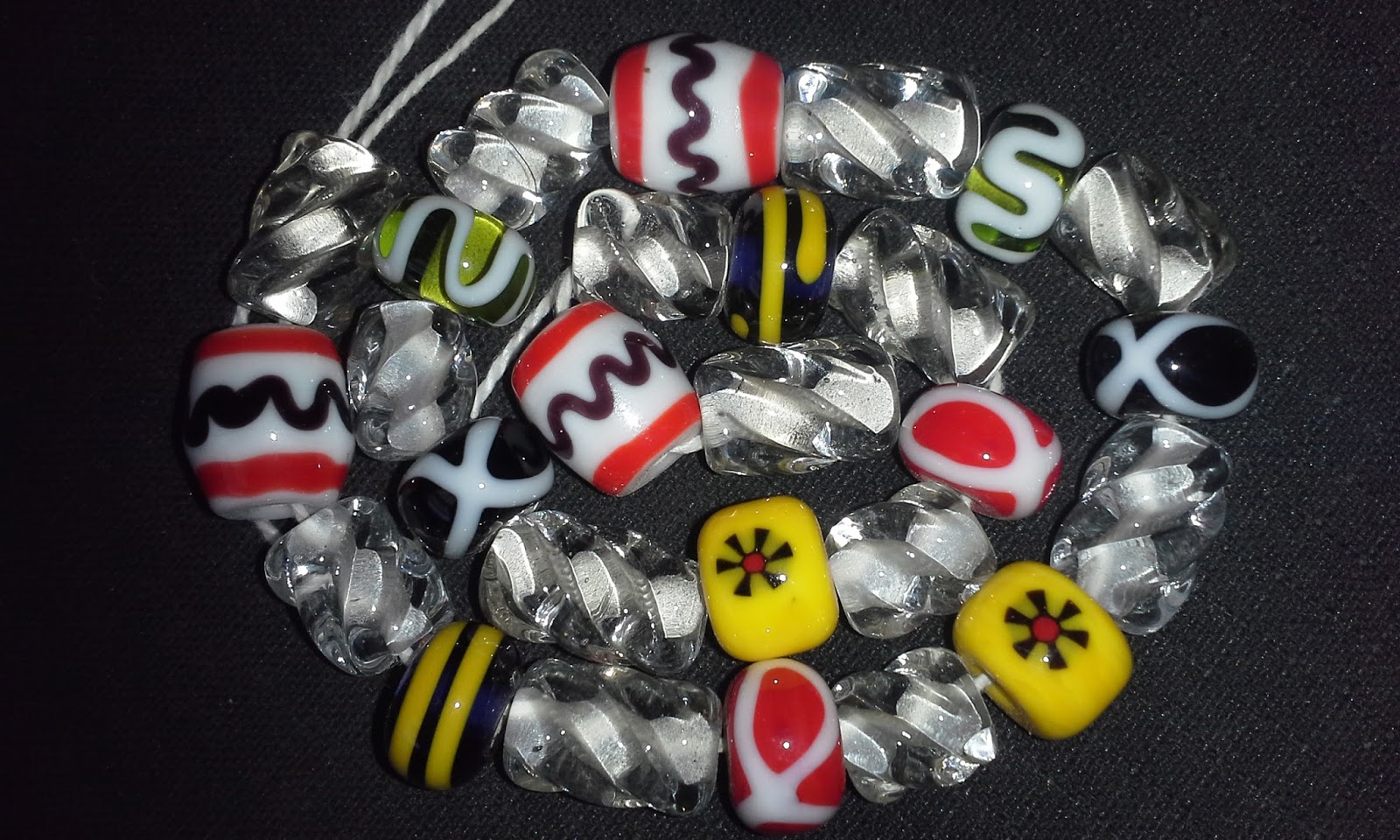
| necklace made for my friend kelly in requested heraldic colors. |
Showing posts with label Period Inspired Bead Strings. Show all posts
Showing posts with label Period Inspired Bead Strings. Show all posts
Sunday, September 11, 2016
Saturday, July 2, 2016
Necklace based on Birka Grave 1081
Note: A better photo is available through the Swedish History Museum at http://historiska.se ,I just cant find it at this exact moment.
Edit: Museum Search Page: http://mis.historiska.se/mis/sok/sok.asp?qtype=f&page=4
Necklace Museum Page: http://mis.historiska.se/mis/sok/fid.asp?fid=363879
Föremål 363879. SHM 34000:Bj 1081
Numbered List of Birka Graves: http://mis.historiska.se/mis/sok/birka.asp?sm=10_7&page=6&zone=&mode=

Sunday, January 31, 2016
Necklace for HRM
 |
| I was asked to make a necklace for HRM to wear at Birka. The necklace was to go with a dark red viking dress and it was part of an outfit that I was told many people were contributing to. |
Monday, June 15, 2015
Bead string for Ysmay

I'm wondering if heraldic colors work well for viking inspired bead strings because of the need for contrast in making a heraldic device. Including both "metals" (yellow and white) and non metals ensures there will be both light and darker colors that contrast well. I happen to think that these three colors work very well together, and as a result, this necklace was a pleasure for me to design and make.
The polychrome beads are based on period Scandinavian beads that I first made several months ago for a largesse gift.
http://elysabethunderhill.blogspot.com/2015/02/viking-glass-bead-tokens.html
You can see that I've used the leftmost first two beads from the above link. By changing only one of the three colors on each bead I was able to make them work with Ysmay's heraldic colors.
I tried to bring a bit of period "randomness" into an otherwise modern symmetrical stringing by alternating which color annular bead (yellow or red) is next to the blue melon bead.
Sunday, February 15, 2015

Sunday, January 25, 2015
Phoenician Glass Bead Necklace


This necklace is composed of 10 store bought metal beads, and 19 glass beads.
It is heavily based on several Phoenician beads and necklaces I've found on museum websites, such as Corning's Glass Museum, the Metropolitan Museum of Art, and the British Museum, or on Christie's auction website.
Inspiration Bead
Inspiration Face Bead
Inspiration Necklace 1
Inspiration Necklace 2
Inspiration Necklace 3
Inspiration Necklace 4
Note: Some of the museum websites indicate that the necklaces may have been recomposed at a later date, so it is not known if a necklace of this configuration would have been worn. One of the auction websites notes that their necklace contains modern metal beads, while another notes that the metal beads are several centuries newer than the glass beads on the necklace. However, while the necklace configuration may not be able to be documented, the glass beads themselves are easily documented using the first two links above.
Research Note on Face Beads
Face Beads started to be made in the 7th century BC, when according to Glenn Markoe in Phoenicians (p. 156-7), "demon masks, animals, and male and female heads began to appear. It's probably more correct to call these figures pendants, rather than beads, as Markoe notes that they were often found on necklaces as special talismans (perhaps these are another variant of "evil eye" beads, as are the stacked dots beads on the necklace above). Markoe says that these beads were likely made at multiple workshops along the Phoenician coast, in areas such as Cyprus, the Egyptian Delta, and Carthage. The pendants started small (3cm) but later grew up to 8 cm in height. These beads traveled widely and have been found throughout the Mediterranean, and in Russian and Europe
Markoe says that these beads were "rod formed," but I think the larger of these beads were more likely to have been core formed. Corning's Glass museum specifically notes that one of these beads was made using this technique. Core forming is a process where small dried balls of clay, dung, and straw were wrapped around a mandrel. The bead was made on that "core" and the core cleaned out once the bead cooled. This results in a hollow bead. It is also easier to make larger beads using core forming, as less glass is required due to the large core.
A previous post of mine on Phoenician beads which includes a reproduction of another variety of Phoenician face beads.
Sunday, January 11, 2015
Viking Necklace
This necklace was made for a friend. She has a viking persona, so she needed a necklace.
My inspiration was the necklace that can be found at this link .
The original colors I wanted were coral and green, which would have more closely matched the necklace above, but the coral effetre 104 COE glass is problematic . It tends to turn grey unless treated a specific way in the flame, something called striking, which I can not do with the torch I have. So we added in yellow and orange instead of the coral, and things got much easier from there on.
This necklaces is mostly made from monochrome beads, just like the example I linked to above. I added in a few different types of polychrome bead designs, and those designs can be documented very easily using Johan Callmer's book "Trade Beads and Bead Trade in Scandinavia."
I tried to keep the organization of the beads on the necklace feeling somewhat random, just like the the viking necklace I used as inspiration. I did this by creating a variety of colors, and shapes in the beads, and also by stringing them onto the necklace in a random pattern.
There are approximately 180 beads in this necklace!
Making this necklace was a useful experience because I had the chance to practice making very simple beads, and it became much easier and faster for me to make these beads over time and after all this practice. I even learned how to make more than one bead on a mandrel at a time.
The necklace I used as inspiration was not all made from glass. In the future I might try to mix glass beads I make with store bought stone beads to more closely match what was done with some period necklaces.
My inspiration was the necklace that can be found at this link .
The original colors I wanted were coral and green, which would have more closely matched the necklace above, but the coral effetre 104 COE glass is problematic . It tends to turn grey unless treated a specific way in the flame, something called striking, which I can not do with the torch I have. So we added in yellow and orange instead of the coral, and things got much easier from there on.
This necklaces is mostly made from monochrome beads, just like the example I linked to above. I added in a few different types of polychrome bead designs, and those designs can be documented very easily using Johan Callmer's book "Trade Beads and Bead Trade in Scandinavia."
I tried to keep the organization of the beads on the necklace feeling somewhat random, just like the the viking necklace I used as inspiration. I did this by creating a variety of colors, and shapes in the beads, and also by stringing them onto the necklace in a random pattern.
There are approximately 180 beads in this necklace!
Making this necklace was a useful experience because I had the chance to practice making very simple beads, and it became much easier and faster for me to make these beads over time and after all this practice. I even learned how to make more than one bead on a mandrel at a time.
 |
| Close up view of a few of the beads. |
 |
| Beads broken out into piles by type |
 |
| Final Necklace. Glass beads (made by me) with store bought amber beads and an amber Thor's hammer. |
The necklace I used as inspiration was not all made from glass. In the future I might try to mix glass beads I make with store bought stone beads to more closely match what was done with some period necklaces.
Sunday, July 20, 2014
Figment Necklace
This necklace was made by request to match the colors of Figment, a Disney character. It will be worn with a viking dress of similar colors. The colors are purple, orange, and pink. It contains annular beads, and lobed/melon beads, both very generic period beads. The larger focal beads are inspired by several types of Hiberno-Norse beads.

Monday, May 5, 2014
Bead Bling
Bead string made for Bruni in heraldic colors (red/white/black)

The necklace was inspired by the string of beads pictured below. The picture is from Birte Brugmannn's Glass Beads from Early Anglo-Saxon Graves. The necklace contains both glass and amber beads, and they come from a Grave in Germany (Issendorf Grave 3549.1). The beads are included in Brugmann's book because a few of the type of polychrome beads shown in this picture (the beads labeled 1) were also found in England.
The beads labeled 1 in the picture are called Candy beads by Brugmann. They are a common early type of Continental bead (5th century). They are characterized by their translucent base (green, yellow, or blue-green) and opaque decoration (mostly in white or red). I have used black as the transparent color, because many of the beads in the picture below are dark enough to look black. I tried to include in the necklace I created one of each polychrome design found the picture below.. I also included ribbed and annular/barrel shaped beads in my necklace, as the historic necklace also has a few types of these beads. I put in a few bicone beads, because Bruni made necklace out of Bicone beads that she entered into this winters K&Q's A&S. I also played around with the colors to include more white in the necklace, and I made my designs much more symmetrical than the string below to fit with modern tastes.

Thursday, February 6, 2014
Gift Basket Beads


Beads for the EK Gift Basket.
 Beads are based on period designs, and pictures of those period beads are included below.
Sunday, December 29, 2013
String of Beads
This was a chance for me to design a small string of beads to give as a gift. I used several bead designs from the Mucking Typology project I did. I tried to make things symmetrical (so it would be pleasing to the modern, or really, my eye). However, by using different designs for each polychrome bead, I tried to keep a bit of the randomness of the period necklaces I have recreated before. I like the result, expect for the fact that the colors I chose don't seem to "pop" and it is not as vibrant as some period necklaces are. I think that is because I used "cool" colors and black as the base color for the polychrome beads.


Wednesday, December 18, 2013
Modern Earrings- based on a historic source

The designs were inspired by/ based on images of Irish and Scandanavian beads found in Birte Brugmann's book Glass from Anglo-Saxon graves. These two beads were chosen because they matched the heraldic colors of the recipient.

Subscribe to:
Posts (Atom)